Types Of 3D Printing
Resin Printing (SLA)
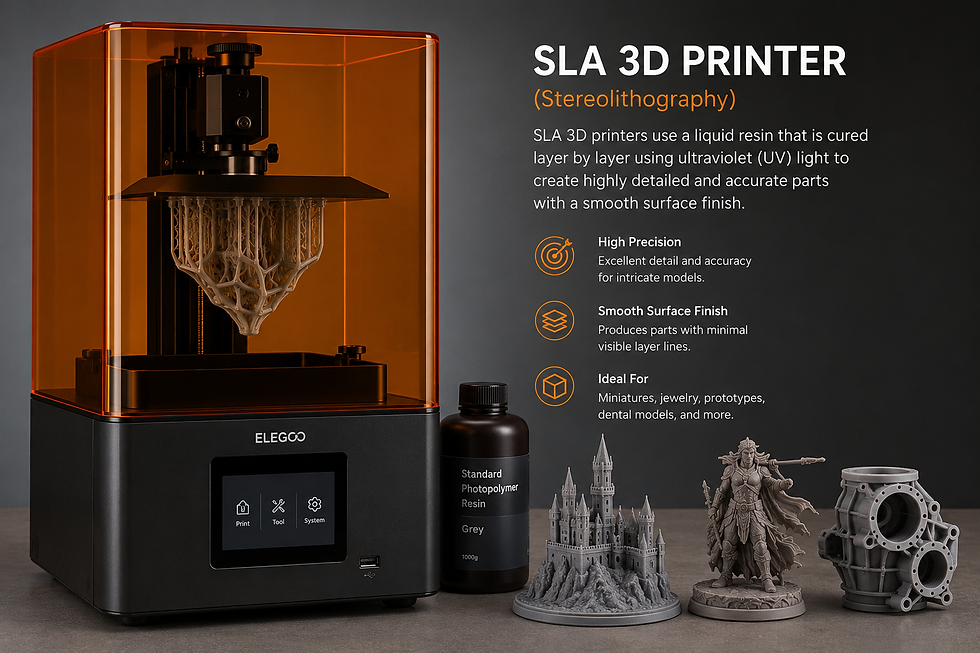
Resin 3D printing uses a liquid photopolymer resin that is cured layer-by-layer using ultraviolet (UV) light. Unlike traditional filament-based printing, resin printers produce exceptionally fine details, smooth surfaces, and crisp edges, making them ideal for highly detailed models, miniatures, prototypes, display pieces, and intricate functional components.
Because resin printing can reproduce extremely small features with remarkable accuracy, it is often the preferred choice when appearance, precision, and surface finish are more important than size or speed. Parts typically require post-processing, including washing and UV curing, before they are ready for use.
Best For:
-
Highly detailed models and miniatures
-
Medical, laboratory, and scientific components
-
Display pieces and collectibles
-
Jewelry and casting patterns
-
Prototypes requiring fine detail
-
Smooth, professional-looking finished parts
Advantages:
-
Exceptional detail and accuracy
-
Smooth surface finish with minimal visible layer lines
-
Excellent for small and intricate designs
-
Sharp text, logos, and fine features
Considerations:
-
Smaller build volumes than most filament printers
-
Parts require washing and UV curing after printing
-
Standard resins can be more brittle than filament materials, though specialty tough and flexible resins are available
When your project demands the highest level of detail and a premium finish, resin printing is often the best choice.
Filament Printing (FFF/FDM)

Filament 3D printing, also known as Fused Filament Fabrication (FFF) or Fused Deposition Modeling (FDM), creates parts by melting and precisely depositing thermoplastic filament layer-by-layer. This is the most widely used form of 3D printing and is ideal for functional parts, prototypes, tooling, fixtures, and larger components.
FFF printing offers an excellent balance of strength, durability, affordability, and material versatility. A wide range of materials—including PLA, PETG, ABS, ASA, TPU, and specialty filaments—allow parts to be tailored for specific applications, from simple prototypes to rugged, real-world use.
While filament prints generally show more visible layer lines than resin prints, they often provide superior durability and can be produced in much larger sizes.
Best For:
-
Functional and mechanical parts
-
Laboratory and industrial accessories
-
Prototypes and product development
-
Large-scale models and displays
-
Custom organizers, holders, and fixtures
-
Everyday replacement parts
Advantages:
-
Strong and durable materials available
-
Cost-effective for larger parts
-
Wide variety of material and color options
-
Larger build volumes than most resin printers
-
Suitable for both prototypes and end-use components
Considerations:
-
Visible layer lines are more noticeable than resin prints
-
Fine details and very small features may not be as sharp as resin printing
-
Surface finish may require sanding or post-processing for a smoother appearance
When strength, durability, affordability, or larger part sizes are the priority, filament printing is often the best choice. It is the preferred manufacturing method for many functional, everyday, and industrial applications.